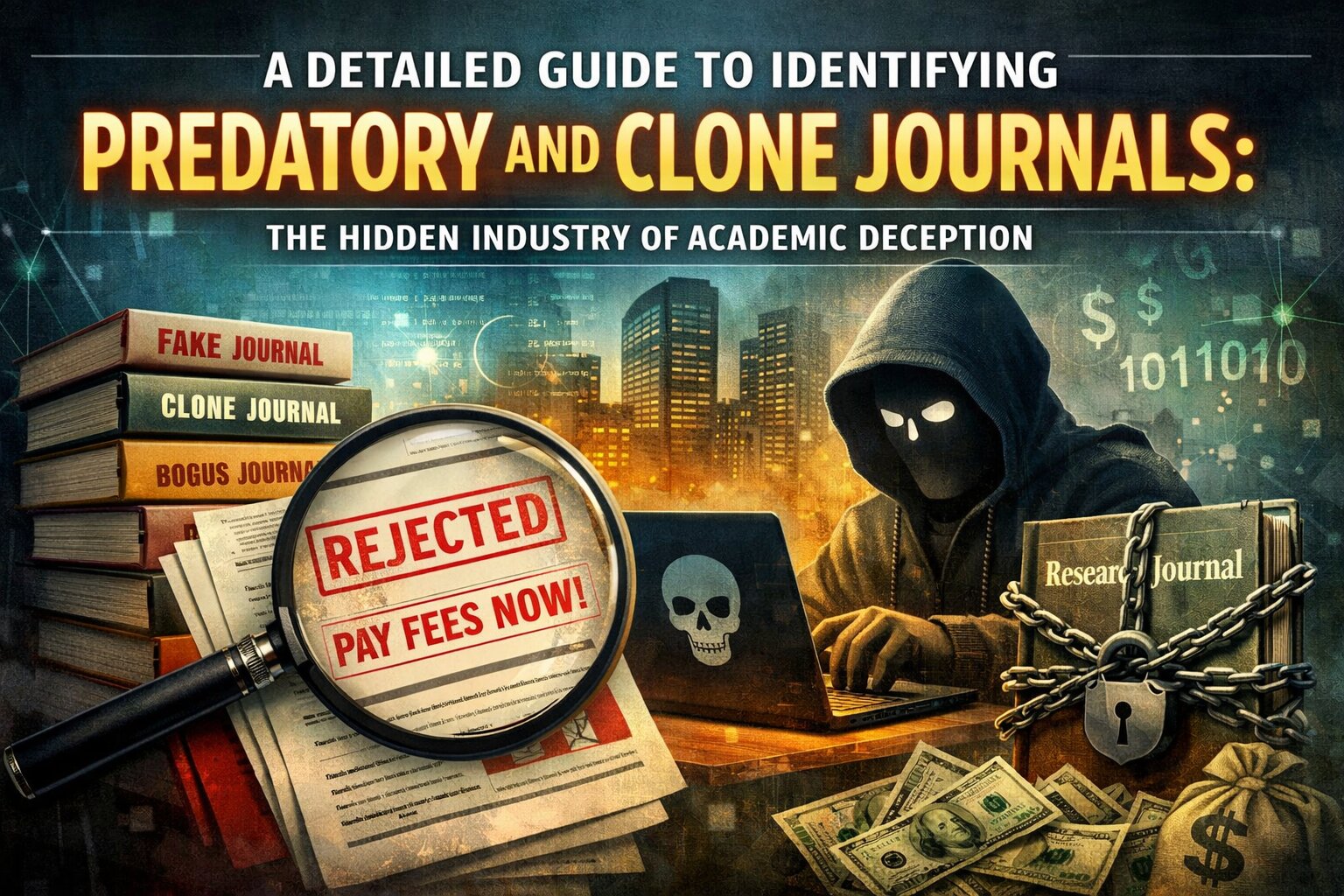
A Detailed Guide to Identify Predatory and Clone Journals : The Hidden Industry of Academic Deception (2026)

Remember:
If a journal promises effortless publication, it is likely costing you something far greater than the APC i.e YOUR CREDIBILITY
Today, the modern research ecosystem continues to evolve, and publishing has come to mean more than just an academic exercise. Publishing impacts promotions, grant funding, the completion of a doctoral degree, the ranking of the institution, and even a job’s contract’s security. Publishing an article has come with pressure to the extent that it has formed a parallel shadow industry: predatory and clone journals. Such journals take advantage of an author’s ambition, urgency, and lack of knowledge and turn scholarly publishing into an unethical business.
Academic publishing remains, in the current age of international scholarship, the most important aspect of knowledge sharing, interdisciplinary engagement, and the advancement of scientific knowledge. For many years, academics and researchers have used academic journals to disseminate findings, have those findings peer-reviewed, and aid in the betterment of society.
The rapid growth of digital publishing, combined with the ‘publish or perish’ mentality pervasive in the academic community, have created a parallel publishing ecosystem that goes to the heart of the issue of whether we can trust scientific publishing. The shadow ecosystem of academic publishing includes predatory journals and fraudulently subsumed journals (clone journals) that are especially geared to taking advantage of the publishing needs of researchers and the drive of many to publish as often as possible.
What are predatory journals?
Predatory journals use fraudulent publishing tactics by using other journals as legitimate publishing houses while also using little to no true peer review. The neglect the authenticity behind true academic work to reap the monetary benefits of masquerading as a legitimate academic outlet. These journals also own the business of aggressive manuscript solicitation, high publication fees, and often have fraudulent editorial boards, false impact factors, and other forms of fraudulent indexing. Clone journals are even further behind than predatory journals and are a true sense of publishing fraud.
Operating under the guise of legitimacy, these so-called journals create misleading front pages that correspond to the names, ISSNs, and websites of legitimate journals. These journals successfully deceive many junior researchers under the institutional pressure to publish because of the career-personal research funding grant obtaining requirements or the degree completion required to publish. Unfortunately, this results in a financial loss to the researchers and a potential reputational loss of a less visible work.
The rise of such journals is due to multiple systemic causes. The combination of rapid growth in the global volume of research, the newer open-access publishing, and the dependence on publishing as the primary means to evaluate the work of academics, and the nearly unrestricted use of unethical publishing practices create a publishing vacuum. Furthermore, the ease of technology is to create websites for invented journals and send bulk email solicitations and fraudulent claims of indexing journals. The net effect is that even scholars with substantial experience, it is still possible to separate fake journals from real ones.
The effects of the hidden publishing economy are much larger than the researcher. It is because publishing flawed or unreviewed research articles, to the best of their knowledge, causes the scientific record to become polluted, results in poor policy decisions, and diminishes the public trust in research.
Additionally, the existence of predatory and clone journals distorts scholarly metrics, compromises the quality of research, and misdirects significant academic research from trusted journals. In this age of information, where credible research is needed to solve the numerous and complex problems, such as improving environmental systems and the health of the global population, the academic publishing system needs to be safeguarded.
It is against this background that there is increased necessity for scholars, organizations, and the government to be educated about the operations of these fraudulent journals, and the ways to detect them. Recognizing the signs, checking the credentials of the journal, and understanding the strategies that are used to manipulate these researchers are the first steps towards protecting academic work. The present blog focuses on the operations of predatory and clone journals and how researchers can practically and strategically avoid these journals. By increasing knowledge on this matter, the scholarly community can protect the integrity of academic publishing, and allow authentic research to be added to the global knowledge.
Knowing deceptive journals has become a matter of professional survival.
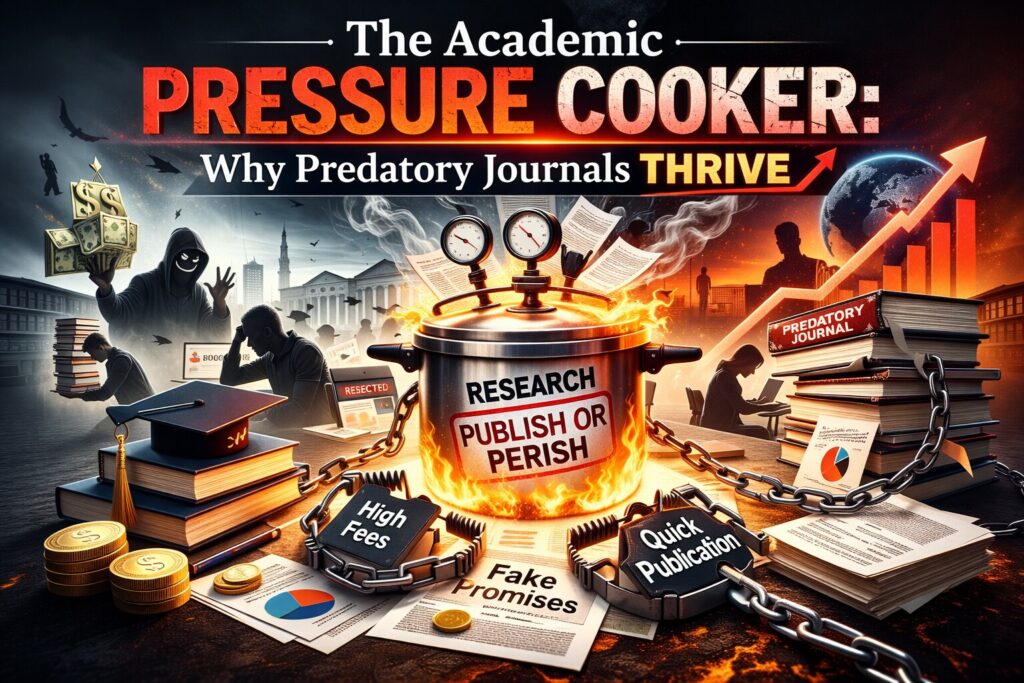
The Academic Pressure Cooker: Why Predatory Journals Thrive
The leading unethical journals exploit the abuse of the open access publishing model, which has changed and expanded global scholarship. The Public Library of Science and BioMed Central are examples of reputable organizations that created a model that enabled scholarly literature to be accessible for free all over the world. However, the open access model that finances its publications through the charging of an Article Processing Charge (APC) has also created a model for abuse.
Jeffrey Beall’s work on the rise of predatory journals brought more notoriety to the term and his work on ‘Beall’s List’ of questionable publishers was one of the early attempts to document arguably predatory journals. His work, though controversial, and eventually removed from the Internet, triggered awareness on the issue globally.
The predatory publishing phenomenon can be attributed to:
Compulsory publishing requirements for Ph.D. submission
Promotion policies focused on the quantity of publications
Research output linked to monetary rewards
The competition among researchers internationally
Absence of specific training in the assessment of journals
Systemic pressure, in brief, sustains the issue.
Definitions of Pretend Journals
Professional journals ensure that the articles they publish are correct and legitimate using methods like peer reviewing and editorial standards. However, a journal that is pretending to be a professional journal will publish articles without any of these controls and are instead focusing on making a profit.
Characteristics of These Journals
Deceptive Practices
Made-up editorial boards
Fake claims about being indexed
Fabricated impact metrics
Shallow Peer Review
Rapid acceptance (2-5 days)
No comments from reviewers
Automatic acceptance when you pay the required fee
Excessive Marketing
Mass email marketing
Overly flattery
Emails outside of your area of expertise
Unclear Pricing
Author Processing Charges (APC) are only revealed after acceptance
Additional processing fees
Websites of Low Quality
Errors in grammar, broken links, and the use of generic design instead of customized
Pretend journals will create what appears to be legitimate journals, skipping the time, effort, and expenses associated with legitimate peer reviewing.
Clone Journals
These are a little more advanced. Rather than making a completely new title like most pretend journals, clone journals will use reputable journals. Some attempts to trick consumers have targeted large publishers like Elsevier and Springer Nature by making fake websites that are the same design as the legitimate journal.
How Clone Journals Operate
Impersonate the name of a real journal
Copy or abuse one ISSN
Use the same format of website design
Change the domain name slightly (.net instead of .com)
Use real editors without permission
Divert submissions and APC payments
Since they copy real journals, they are more difficult to spot impersonaters.
Psychological Tricks of a Predatory Publisher Journals using Predatory Publishing Pscyhology:
Imminence “Submit in 48 hours!”
Please “We admire your fantastic work.”
Deficiency “We have a few spots left.”
Authority Fake Impact Factors and Indexing.
FOMO “Your coworkers have published with us.”
Learning the tricks of the manipulative strategies keeps researchers focused. A Structure to Identify Predatory Journals
Step 1: Verify Indexing Claims Checking the indexing out of the official Scopus, The Web of Science, and The Directory of Open Access Journals, should be your first step. The logos of the journals should be checked.
Step 2: Look at the journal’s website for: Well defined scope and aims – A transparent peer review – An ethical policy – A retraction policy – A transparent editorial board Legitimate journals have submission periods.
Step 3: The editorial board – Do the editors work for known institutions? – Do they list the journal in the institutional profiles? – Are there institutional emails? You can always approach editors through the university emails.
Step 4: Review the duration of the peer review
Real peer review, usually involves.
Screening takes 1-2 weeks.
External review takes 3-6 weeks.
Revision rounds
It’s a little strange if you get accepted within 72 hours.
Step 5: Checking DOI Registration
You can validate the DOI registration in Crossref. If you have DOIs that are broken/inconsistent, do not submit.
Step 6: Assess Memberships and Ethical Affiliations
Check the journal’s membership with the:
Committee on Publication Ethics (COPE)
Think. Check. Submit. initiative
Note: Memberships with COPE are frequently falsely claimed, so verify from the list of members.
Step 7: Verification of Publisher Details
Investigate the:
Physical address
Business address
Phone contact
Age of domain registration
If the domain is new, and the publisher claims to have operated for several decades, that is a serious issue.
Clone Journals: Extra Checks
Clone journals require further verification:
Check Website URL Independently
Do not use publisher links from emails; go to the main page of the publisher directly
ISSN Portal
Check ISSN and ensure the:
Title is complete
Publisher is the same
Country is the same
Design Uniformity Check
Poor copies of logos
Inconsistent layouts
Old news
Payment Instructions
Genuine publishers will not require
Personal bank transfers
Payment to other third parties
Impacts of Publishing in the Wrong Place
Publishing in predatory journals will mean:
Promotion review is likely to be denied
Institutional credit will be denied
Reputational damage
No further grants
Retraction of submitted degree
Some institutions are known to blacklist certain journals.
The Effect on International Research Integrity
Predatory publishing:
Corrupts scientific research archives
Disseminates unverified studies
Manipulates policymakers
Fools researchers in poorer countries
Erodes societal trust in scientific knowledge
The greater effect is systemic trust deficit in the academic landscape.
Case Study: Red Flags Analysis
Red Flag 1: Overly Inclusive
Journal of Science, Technology, Arts, Management, Medicine and Humanities
Red Flag 2: Illegitimate Metrics
Watch out for:
Universal Impact Factor
Global Citation Index
International Scientific Impact Value
These are not recognized metrics
Red Flag 3: Unrealistic Special Issues
Multiple special issues every month
Red Flag 4: No Retraction Policy
Correction and retraction processes are stated by ethical journals
Red flag 5: Submission by Email Journals
Legitimate journals do not use simple gmail address journals and instead have organized systems for submissions.
Institutional Accountability
Institutions should:
Conduct workshops on awareness
Give journals that have been approved lists
Train PhD students on ethics in publication
Promote quality over quantity
Encourage mentorship
Shift from focus on volume to impact in academic governance.
15 Point Checklist to Safeguard Researchers
Check before submission that:
1. It is independently indexed
2. It has a verified ISSN
3. It has a legitimate publisher
4. The editorial board is legitimate
5. Peer review is described clearly
6. APC is clear
7. DOI is active
8. COPE membership is valid
9. The age of the domain is reasonable
10. The previous issues are consistent
11. The retraction policy is clear
12. Contact info is not concealed
13. The publication timeline is realistic
14. The impact metrics are recognized
15. You have consulted your mentor
If multiple questions exist, do not proceed with submission.
The Ethical Obligation of Researchers
Researchers are the guardians of knowledge, and choosing a journal is an ethical decision. Publishing in predatory journals:
Dents your CV
Dents the CV of your institution
Dents the CV of your field.
Being informed is the best first step.
The Last Word: Watchfulness is the Essence of the Matter
Clone and predatory journals are simply a nuisance, and a nuisance of the highest order at that.
They grow in environments characterized by urgency, metrics, and a lack of mentorship.
The answer includes:
Teaching
Assessment
Reform
Leadership
With research informing policy, society and international discourse, safeguarding the authenticity of research publications is vital.
If the publication process seems too simple, too quick, or too complimentary, question it before you hit submit.
Once lost, the trust in academia is hard to regain. Act with prudence
Conclusion
Predatory and clone journals are a threat that is often overlooked, but still very serious. Some journals as a means to lure and trap exploitative researchers who are pressured to publish, and are highly covetous of such a predatory trap. Especially with today’s academic climate that rewards research based on quantity instead of quality, somewhere along the line arbitrary, deceptive journals and other similar journals have been increasingly predatory.
Such deceptive journals masquerade as legitimate journals, boasting about their fast and efficient peer review processes, and quick journals, and solicit authors, all taking part in a predatory publishing scheme driven by profit instead of integrity. The killing of publishing in a predatory manner places an irreversible scar on the research, the lack of integrity of the research is inter sadly entangled with that of the research, the research, and the research.
Fortunately, the academic community is beginning to identify the more deceptive methods of researcher journals as a response of the community. Recognizing the predatory and deceptive journals is more than just editorial judgment. It is an essential and fundamental skill that all researchers are required to possess.
Aiding researchers demands assessing journal websites, assessing journal-indexing claims, assessing editorial board ownership, and monitoring journals to avoid unethical publishing. Training, awareness, and ethical publishing practices are needed. Publishing practices should be assessed based on the quality and the impact of the research rather than the quantity.
Predatory publishing affects mostly early career researchers. They need guidance from senior researchers, mentors, and journal editors. Discussions, guidance, and institutional mechanisms can strengthen the ethical publishing decisions made by scholars. They can also strengthen the monitoring of fraudulent journals and fake critical academic publishing.
Integrated approaches of the publishing research community and technology can enhance monitoring, transparency, and the integrity of publishing. Only technology used for deceptive publishing needs to be changed.
In the end, combating the erosion of integrity within academic publishing is an effort that we all share. Each researcher selecting a reputable journal, each institution that emphasizes a respect for scholarship, and each editor that commits to solid peer review defends the essential elements of the advancement of science. Researchers have the ability to combat deception through the discovery of predatory and clone journals, and to educate others within the academic community. It is also the responsibility of the research community to protect true scientific research that can lead to the discovery of new ideas, innovative research, or even the advancement of mankind’s knowledge.
Final Thought
The importance of trustable dissemination of knowledge and scholarly misconduct is conflict that is important as ever. Global research credibility, reliability, and integrity have challenges such as predatory and clone journals, and unethical publishing. Junior researchers and researchers in graduate studies have increasing publishing pressure. This often causes the value of a publication to overlook the importance of a peer review and ethical publishing. Publishing and quantity of research should not be a goal of a research. Quality and societal contribution of a research should be the goal.
Everyone in the research community shares the responsibility of protecting academic integrity. Researchers are expected to develop a sense of critical scrutiny, confirm the authenticity of journals prior to submission, and be transparent and academically rigorous rather than prioritizing ease. Institutions and mentors are expected to guide novice researchers on the dangers of unethical publishing and encourage them to engage in responsible research. The academic community has the ability to dismantle the clandestine industry of misinformation and exploitation through collective vigilance and the support of ethical publishing practices.
The greatest potential for advancement, innovation, and transformation of society lies in knowledge. Thus, protecting the means of dissemination of that knowledge is of utmost importance. Researchers that are knowledgeable, careful, and committed to the ethics of scholarly publishing defend their work and the integrity of science. The greatest protection against erosion of integrity within academic publishing is awareness.
My Publications or visit my LinkedIn