Ensuring Ethical Publication Practices in the Artificial Intelligence (AI) Era: Addressing Misconduct and Predatory Publishing (2026)

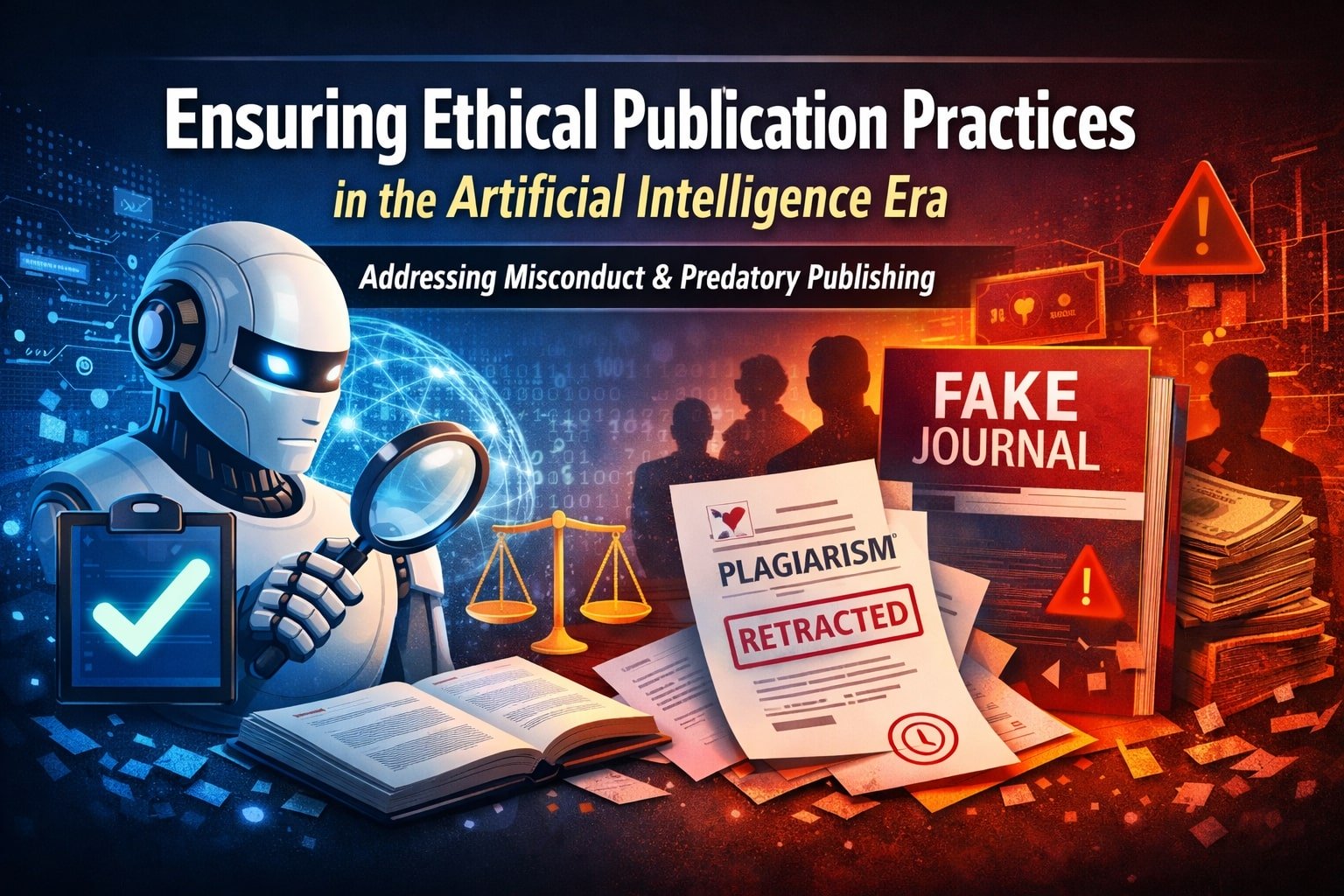
In the world of science, we typically trust the credited journals to publish the most credible work. Sadly, the world of science also runs on “publish or perish”, so the jeopardy gets pushed lower and lower along with the chance of misconduct being caught.
Artificial Intelligence Involvement in Manuscript Publication
Artificial Intelligence (AI) is rapidly shaping different aspects of the manuscript publishing process. It presents both benefits and challenges. Manuscript-focused AI tools help to improve efficiency and the quality of manuscripts, and help to identify and address ethical issues in manuscripts. Jounals use predatory AI tools to assist with plagiarism detection, language editing, reference management, statistical checking, and even preliminary screening of submissions.
The increase in instances of publication misconduct is also partly due to the inappropriate use of artificial intelligence in the writing and publishing processes. Automated peer review fraud, undisclosed use of AI for content generation, image generation and manipulation, and the use of fictitious data are examples of misconduct. Thus, to ensure that AI is a helpful resource and not a tool for academic dishonesty, the use of AI must be accompanied by journal policy compliance, a clear policy regarding the use of AI, and a mechanism for ethical review. The merging of Artificial Intelligence and good human editorial decision making is a necessity in order to protect the sanctity of scholarly publishing.
Publication ethics is the basis of credible and trustworthy communication. The academic world is expanding, and along with it, the role of research misconduct, which includes things like fraud, plagiarism, editorial problems, authorship problems, duplicate submissions, and the ever-growing predatory journals. The complexity of these problems is growing. The tools on the bookshelf along with the process to complain and possibly appeal, the ethical practices, and everything else related to these problems.
New AI tools provide assistance in things like writing and editorial work, but come with their own ethical problems. This blog is going to focus on the negative, and aim to explain publication misconduct in order to explain the importance of transparency, conduct, and accountability in research publishing.
When people cut corners to get ahead, it is the whole research world, the journals, the universities, and the whole field of research that pays for it. Each time misconduct goes unchecked, the process is slowed that much more.
In this article I will categorize the principal types of misconduct regarding publishing, discuss how the related complaints and appeals processes pan out, discuss the risks associated with predatory publishing, and defend the use plagiarism detectors such as Turnitin, Urkund (now Ouriginal), and various free and open-source alternatives as being tools for upholding academic integrity, rather than being optional, as some may suggest.
In academia, a publication represents much more than a mere bullet point on a CV. It is a primary means of disseminating research, establishing a global presence and reputation, and advancing one’s career. It is no surprise that as the incentives to publish increase, the opportunities for dishonest behaviors are also increasing. We are witnessing an increase in the number of falsified datasets, unacknowledged text duplication, ghost authorship, and paper mill journals that will accept any text for a fee.
All of these behaviors and practices increase the level of suspicion that exists within the scholarly community and diminishes the level of trust that needs to exist. If we hope to preserve the reputation of the scholarly work we do, we must be able to recognize these behaviors and practices and take proactive steps to mitigate them.
Every publication misconduct paves the way for the erosion of trust in the integrity and accountability of the scholarly community.
There are multiple forms of research misconduct. These are, plagiarizing sentences, self-plagiarizing by submitting the same paper to different journals, fabricating or falsifying research, manipulating images to support erroneous conclusions, ghost-authorship, courtesy authorship, citation manipulation, and many more. Some of these are done with the intent to mislead; others, particularly with novice researchers, may simply be a result of ignorance of the field’s ethical regulations. In all these, the consequences can be dire. A paper can be retracted, institutional action can be taken, and a researcher can earn a mark that will last all the way to the end of their career.
Predatory publishing is another major issue in the field. These so-called journals abuse the open access model. They lure researchers with promises of rapid publication, low fees, and high but meaningless impact “metrics” and avoid any real vetting or responsible editorial work.
Junior and less experienced scholars are especially vulnerable to these predatory outlets. Having their work published in such venues undermines their work and the research field as a whole., and the entire body of literature becomes cluttered with unchecked, dubious data.
The good thing is that the research community is gaining tools and techniques to tackle the problem, from Turnitin to iThenticate to the plagiarism checker in Grammarly, authors and editors can confirm that work is truly original and ethically sound.
The Committee on Publication Ethics, the International Committee of Medical Journal Editors, and the World Association of Medical Editors all provide some of the most clear and enforced guidelines for their ethical commitments in the publication of their research. Many journals have begun to increase their expectations. It is not uncommon for journals to request that authors sign official statements, provide raw data for public access, and report any financial or personal conflicts of interest.
When misconduct occurs in research, whether you’re the author of the paper, the peer reviewer who read it, or the editor who handled it, it is important that clear and unambiguous mechanisms exist for reporting, investigating, and appealing. Journals have systems for dealing with these issues, as do most research ethics offices at your institution.
The entire process can feel dizzying
If you don’t know what help is out there, don’t have backup, or if your records are scattered and incomplete, it can feel even worse.
In this blog, we will be your all-in-one guide and help you understand and tackle publishing misconduct. We will show you how to prevent it, recognize it and set it right, using real-life cases to add some flavor. We will teach you how to understand the ins and outs of the complaint and appeal systems, and teach you how to identify predatory journals before they sink their teeth into you.
This guide is for students, veteran researchers, peer reviewers, and editors. We will help you protect the academic integrity of publishing as you make responsible publishing decisions and assist in building an equitable and trustworthy research ecosystem.
The threats are real, and so are the answers. Let’s get started and face them together.
Unpacking Publication Misconduct
Unethical conduct associated with the publication of the results of research activities is called publication misconduct. It may happen at any stage of the process including, research, writing the manuscript, submission, review, and even after publication. The most frequent examples are:
Plagiarism: Taking and using another’s work or ideas without appropriate attribution.
Data Fabrication: Making up data or modifying data or results of research to obtain a desired result
Duplicate submission: Attempting simultaneous publication of the same manuscript in two or more journals.
Redundant Publication: Republishing the same work that is already published without appropriate citation or for no justifiable reason.
Authorship Misconduct: Including as authors those who did not do the work and excluding those who did.
Conflict of Interest Disclosure Negligence: Not disclosing conflicting personal or financial interests which may compromise neutrality while undertaking a specific study.
Citation Craze: Refers to self-citing or citing works of fellow collaborators to increase the citation count in a given publication to an unrealistic number.
All of the above affect the credibility of scholarly publishing and can deeply damage academics.
How to Spot Publication Misconduct
Publication misconduct requires a blend of technology and people for effective detection. Journals, institutions, and publishers have developed specific policies aimed at the identification and prevention of unethical behavior in academic publishing.
Peer Review
Peer reviewers generally are the first stage of detecting such misconduct. Their expertise in the field allows them to identify inconsistencies, plagiarized sections, and illogical data. However, Peer review does not guarantee accurate detection in which case; additional verification methods are required.
Editorial Review
Executive editors in reputable journals usually review manuscripts looking for compliance with ethical standards.
These include;
Control of references and citations.
Check authorship agreement.
Ethical approval of human or animal subjects research.
Anti-plagiarism Software
Current technological tools like Turnitin and Urkund are necessary for comparing submitted documents to other published works for similarity and checking for textual coincidence.
These tools will be elaborated on later in this blog post.
Complaints and Appeals in Scholarly Publishing
There is an expectation that scholarly journals and publishers will have clearly defined procedures for dealing with complaints and appeals. This is normally how it works:
A. Filing a Complaint
A formal complaint can be brought forth by any of the following:
Reviewers
Readers
Co-authors
Editors
Whistleblowers
Each of these parties can trigger a complaint based on breaches of ethics, conflicts of interest, data falsification, or other forms of peer review rigging. Most journals now have websites with designated email addresses or online forms to submit complaints.
Investigation Process
After receiving a complaint, a journal:
Preliminary Assessment: The editor or ethics committee assesses the validity of the complaint and its relevance to their jurisdiction.
Inquiry and Documentation: If found to be valid, further steps are taken which might include contacting the authors, reviewing the peer review logs, and examining plagiarism check reports.
Institutional Notification: The author’s institution may, in more extreme circumstances, be notified so that they may conduct their own investigation.
Resolution and Appeals
Depending on the decisions made: Public Notice, Article Retraction, Correction Notice, ban submission for a set amount of time, set period of time, change of an article’s status, etc. The decision can also include periodic review of submitted materials. If dissatisfied with a decision made, authors of an article reserve the right to appeal any of the processes done before and during the decision-making process.
Independent committees review the appeals to ensure impartial appeal scrutiny.
Predatory Publishers and Journals
One of the more insidious forms of publication misconduct involves predatory publishers. These entities take advantage of the open-access model of publishing by charging manuscript processing fees without providing any genuine editorial or peer review work at all.
Characteristics of Predatory Journals
Incessant unsolicited spam pitching manuscript submissions to the journals.
Circulating fictitious impact factor and claims of being indexed.
Sham editorial boards composed of unqualified or uninformed individuals.
Lack of published and documented peer review.
Publication and release dates that are excessively too fast.
Inadequate perpetual archiving and not assigning DOIs.
Dangers of Publishing with Predatory Journals
Loss of reputation and credibility.
Failure to be indexed in recognized databases including Scopus or Web of Science.
Little, if any, scholarly bona fide recognition or impact.
Administrative and custodial efforts to remove works perceived as inappropriate, but to remediate them is increasingly difficult.
How to Identify and Avoid Them
Research is made easier by tools like Beall’s List (now archived) and the platform Think. Check. Submit. Verifying the journal’s absence is also confirmed in the DOAJ, COPE, or ICMJE.
Role of Plagiarism Detection Software
Tools for detecting plagiarism are crucial in tracing and controlling one of the most common types of publication misconduct.
These systems analyze text to find similarities using vast databases of both published and unpublished works.
“A. Turnitin”
As one of the most common systems in education, it cross-checks papers with:
A multitude of webpages.
Reservoirs of previously submitted documents.
Educational and journal aggregator databases.
With Turnitin, matched content will be highlighted on the Similarity Report and educators, as well as editors, will be able to evaluate if the content is plagiarized. Since it also offers feedback functionalities, it proves to be very handy in teaching settings.
“B. Urkund (Ouriginal)”
Another strong international competitor of PlagScan is Urkund, which later incorporated into Ouriginal. Its offerings include:
Plug and Play to LMS (learning management systems).
Known for precise originality check documents.
Ability to process files in different languages and forms.
They focus greatly on usability and privacy of information, which escalates its popularity among European educational institutions.
“C. Open Source and Free Tools”
Even though these services are not as powerful, there are multiple free sources that can provide adequate services for plagiarism detection. A few of the tools include:
Plagiarism Checker X: Allows users to enter two documents at the same time and scan them for plagiarism.
DupliChecker: A basic plagiarism tool provided free online.
PlagScan: Offers free and paid subscriptions and is popular in the academic world.
Quetext: Well-liked for personal use, though the free access is restricted.
Google Search: Not a purpose-built tool, however, entering the text in quotes can help find identical works.
Detection Tools’ Bound Constraints
False Positives: Appropriately cited works or common phrases are nonetheless flagged.
Limited Language Support: Some tools have difficulty with English documents.
Paraphrasing Evasion: More advanced forms of disguised plagiarism through paraphrasing or translation may go undetected.
Therefore, human discretion is still needed together with automated systems.
Ethical Publishing Standards Best Practices
These are methods to avert publication misconduct:
Appropriately cite all sources without relying on secondary sources.
Express original thoughts or language, unless you are quoting someone.
For work with human and animal subjects, secure ethical clearance.
Avoid submitting to predatory journals.
Establish clear/authorship criteria.
Ensure plagiarism is checked before submission.
Follow the journal’s policy on conflict of interests.
Conclusion
The rapid advancement in artificial intelligence (AI) tools over the last few years, may serve the dual purpose of helping to publish ethically while also posing risks in maintaining ethical publishing. Journals and other publishing institutions have artificial intelligence tools to assist in keeping the publishing process transparent and in managing workloads.
These tools detect plagiarism, image discrepancies, data inaccuracies, and other discrepancies in authorship. When using these tools, the editors and authors are able to enhance the quality of the manuscript, keep the processing time to a minimum, and adhere to publishing ethics. Unfortunately, the use of AI in an undisclosed or unregulated manner, including the use of bot-generated text, fake peer reviews, or other forms of unethical publishing, can compromise the integrity of research and the credibility of science.
The integration of AI in publishing will only be made possible by creating frameworks that will govern its use in ways that benefit society. Systems like AI will streamline certain processes, but the need for human oversight in the decision making processes with AI will need to be at the center of the system. This will make sure that AI will only be used to enhance the quality of the judgement that scholars make, not to replace it. Using AI in ways that are beneficial will be in the best interest of combating predatory publishing, publication malfeasance, and helping to maintain the integrity of research and its communication across the world in the digital age.
The tools that editors and reviewers use are expanding with the development of digital tools and publishing that is free for everyone to access, but the tools that we have available to monitor for malfeasance are also expanding, making the problems easier to manage. Everyone that is involved in the process of publishing, including those that are edited, reviewed, and published, are charged with maintaining the integrity of the communication that is scholarly. This is the same for open access publishing and digital publishing; the opportunities for malfeasance are great, but the tools to combat those problems will used to combat those problems.
The tools that are available for analyzing game theory, Turnitin, Urkund, and open source tools will widen the scope of available research. these are tools that will confirm the malfeasance of published research, and will also confirm that the research is beneficial to society.
Final Thought
Publication misconduct should not be seen as the problem of an individual or a few individuals, but a systemic flaw that weakens the integrity, trustworthiness, and overall advancement of scholarship around the world. With a relentless “publish or perish” pressure, all stakeholders, i.e. researchers, institutions, and scholarly publishers, need to heighten their emphasis on the most rigorous ethical standards. The integrity of the scientific record cannot be built solely on new findings; it must be equally constructed through integrity, openness, and responsibility at every step from study conception to publication.
My Publications or visit my LinkedIn