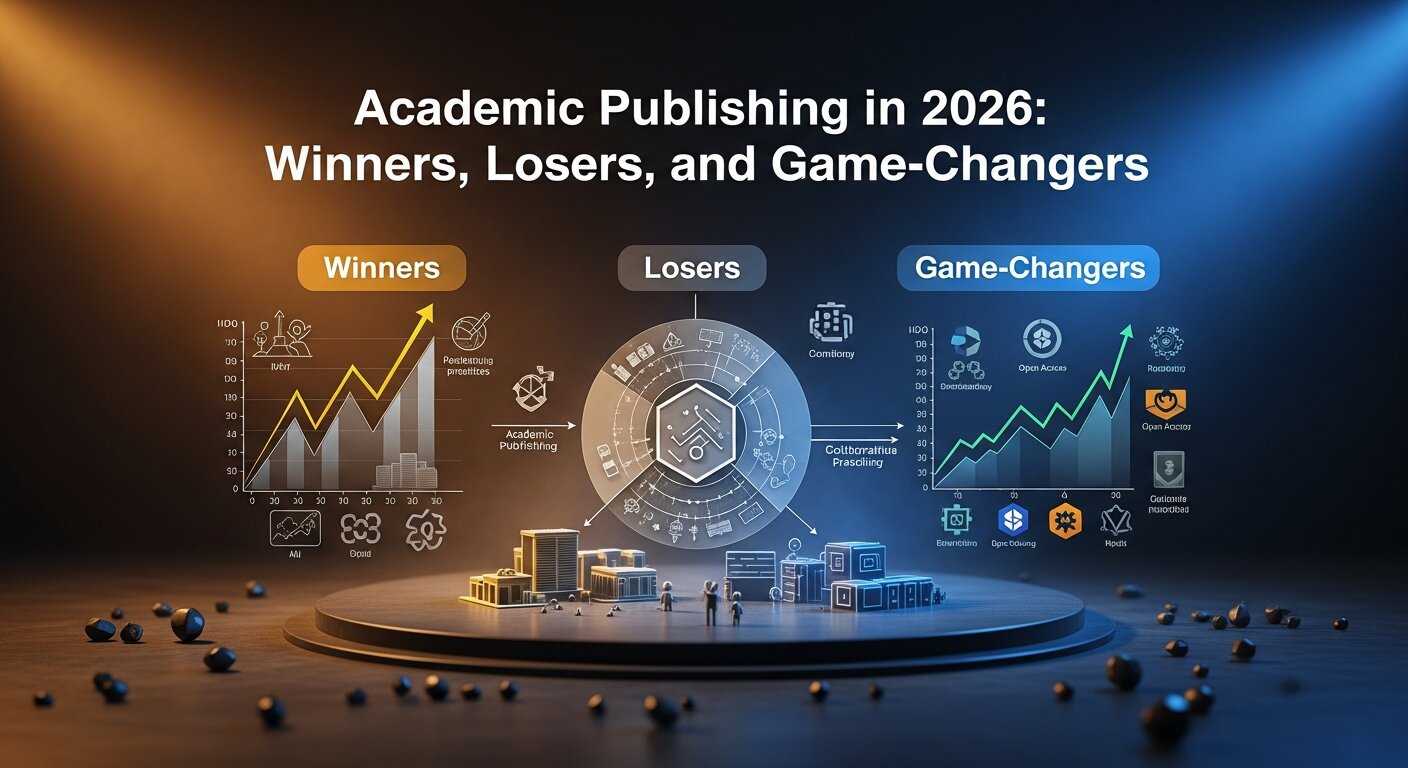
Academic Publishing in 2026: Winners, Losers, and Game-Changers

From Submission to Citation: How Research Communication is Being Redefined
A notable example of publishing’s rapid change is its ability to process journal submissions significantly faster than it did ten years ago. Journal submissions are no longer just processed quickly, but they are processed algorithmically. Publishing has started to employ patent systems, increasing the speed for processing and peer review to the point that the publishing process has now baked in an impatience.
In this post, we will look at the trends currently underpinning the world of academic publishing and its potential implications in the future, including the trends associated with Open Access, alternative impact metrics, the evolving peer-review process, and the increasing equity in the publishing process, all focused on how knowledge will be constructed in the future. These shifts are especially important for academic and non-academic audiences, including those in labs, those on the library side of the desk, or those interested in the dissemination of knowledge on the Internet.
Open Access NOrm
As the years progress, Open Access publishing has only become more commonplace. Our research suggests that, in 2026, an increasing amount of research will be funded via research grants that value Open Access publishing. As more grants are awarded that value Open Access publishing, the more research behind paywalls will become the oddity.
The preprint services arXiv, bioRxiv, medRxiv, etc. are now more than just useful services. They are now essential for research regarding AI, health, and climate. There are also negative trade-offs for this shift, such as huge article-processing charges, predatory publishers, and gaps in equitable access to global publishing.
Rethinking Research Impact: Beyond Citations
In addition, ways to measure research impact are also changing. Traditional citation-based methods in measures such as impact factors for journals or individual researchers’ h-indices are now useless. By 2026, in addition to traditional measures, scholars will be considering altmetrics as measures, such as social media mentions, downloads of the paper, mentions in news stories, and mentions in blogs.
These metrics are a poor proxy for the research impact of a paper, such as its dissemination from beyond the typical academic environment of laboratories and lecture halls. These metrics, however, require us to consider what we are attempting to measure, the research impact, in a more thoughtful manner and to consider what we are measuring to be meaningful, equitable, and useful.
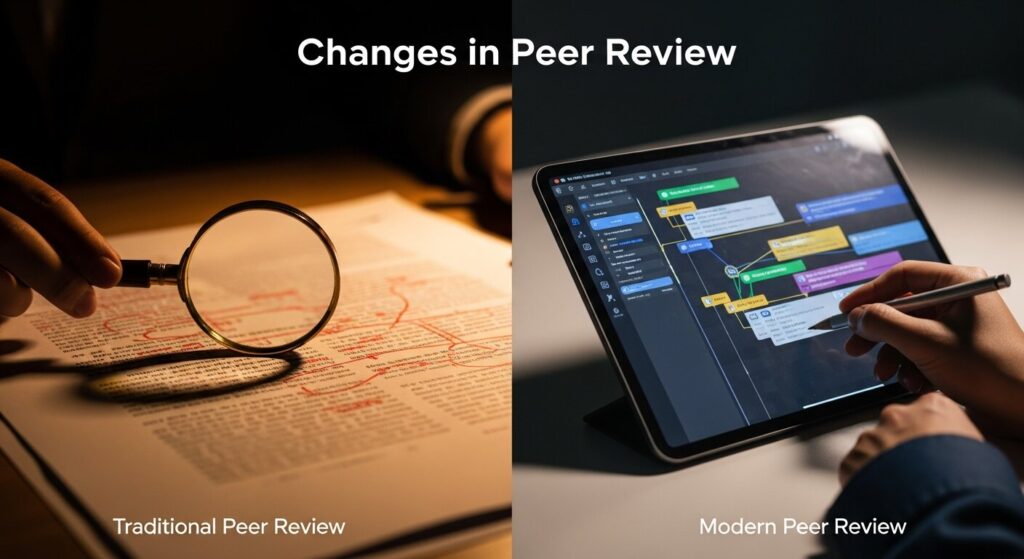
Changes in Peer Review Processes
One of the most significant examples of the changing nature of the peer review process. Historically viewed as a lengthy and closed process, peer review is receiving a makeover. Journals are beginning to use open peer review and are experimenting with artificial intelligence for initial screenings and other processes. Reviewers are able to comment and provide feedback regarding reviewer bias, data privacy, and the potential for academia to lend too much of a judgemental role to automation.
Towards Maximizing the Potential in Publishing
Finally, a long-standing bias in the publishing industry is submitting research from the Global South. Publishing houses and editors are beginning to accept research in multiple languages in order to expand their editorial boards. Publishing houses and editors are beginning to accept research in multiple languages, and the bias of ‘who is published and cited’ is beginning to change. Real and significant change, however, is happening at a snail’s pace and enormous equity gaps continue to silence countless voices.
Why is this important?
These changes mean that the entire research life cycle—how research is done and disseminated— is being redefined. This impacts every researcher fighting for visibility, every user seeking free information, and every institution on the line. Documenting these changes is the best way to ensure that the research stays ethical, open, and most importantly, changing the world.
In the year, 2026, the academic publishing environment will undergo unprecedented transformation. New technologies and new access, open publishing, and funding shifts combined with changing researcher expectations are driving this change.
Below are the ten most important trends impacting scholarly publishing.
- Open Access Takes Center Stage
Increase in Gold, Diamond, and Platinum OA
Gold Open Access: In most academic disciplines, paying for Gold OA is becoming the norm. Major publishing houses, for example, Springer Nature, claim that 50% of the articles they publish are now open access. Two newer models are also becoming popular.
Diamond OA: No fees are charged to authors and readers; costs are covered instead by libraries, universities, or research consortia.
Platinum OA: A community-based alternative similar to the above provides for the abolishing of author fees to be replaced with local funding.
The launching of these options is enabling scholars to begin dismantling the walls of subscription-based publishing.
National-Level Deals & Equitable Access
The ONOS initiative in India is attempting to acquire and consolidate access to 13,000 journals for a total of ₹6,000 crore.
University consortia in several countries have begun to negotiate deals where the costs are tied to the open-access model of publishing so that universities pay the article processing fees and remove the paywalls. This increases access for the general public and is a significant gain for them.
How OA Pays Off
Most of the revenue that Springer Nature anticipates for 2026, which is expected to be between €1.89 and 1.94 billion, will be derived from open access journals. Additionally, Bloomsbury benefited financially from the open access model for its textbooks that are positioned next to its bestselling novels.
Advantages of OA
Maximized exposure and citation likelihood
Rapid spread of findings
Heightened public interest in science.
Challenges
Open access brings with it the following drawbacks, despite its positive aspects:
High APCs can exclude researchers with limited funding.
The model is open to predatory publishers.
The disparity between well-funded and poorly funded institutions is inequitable.
To put it simply:
“Research is becoming more accessible, but it is not necessarily becoming more affordable.”
- The Peer Review Process is Getting Quicker and more open.
Although peer review is one of the most crucial factors of academic publishing, it has faced a number of criticisms, particularly with regard to its duration and lack of transparency.
What’s New?
Open Peer Review: The reviews and comments of the reviewers are public
AI-assisted Screening: Tools are used to evaluate plagiarism, data, and quality of the references
Quicker Review Cycles
Issues
AI Bias
Privacy
Automation Dependence
“The aim is to have quicker, clearer and fairer reviews, with human oversight.”
- AI and Machine Intelligence: Partner or Threat?
Wise Review and Workflows: Publishers have started implementing AI, either individually or in hybrid teams, to review manuscripts, identify plagiarism, verify references, and review assignments. Although these tools have increased the overall efficiency of the system, concerns regarding inherent biases and substandard control have grown.
Authorship and Fair Use: Researchers are using large language models to ideate and draft, which raises concerns regarding the appropriation of credit and ownership. For this reason, Wiley, among others, has required scientists to disclose the extent of AI involvement.
Abuse Prevention: The emergence of AI peer review mills and automated bogus journal publishing has illustrated the immediate need for robust ethical guidelines and copious regulations.
“AI is an excellent tool, but human reasoning is still essential.”
Data Transparency and Open Science
Share the Files Up Front: More journals and funding agencies are requesting the authors to upload raw data to Dryad, and other similar sites for institutional repositories, to allow other teams to review and replicate the work.
Rise of Registered Reports: A good number of journals now allow researchers to submit their research design prior to data collection. This allows for peer review of the research design, which aims to eliminate potential biases and help improve the integrity of the research.
Preprints and Rapid Dissemination: The practice of quickly sharing incomplete work is widely recognized, with platforms such as arXiv (hosting >2.6 million papers, >20,000 new papers each month).
While the open-access model has many flaws, it has many benefits. A prime example is the quickly debunked paper from MIT Economics posted in May 2025.
“Science is becoming more open, transparent, and collaborative.”
- Metrics Beyond Citations
Integrating Altmetrics: More researchers and publishers are looking at social media, downloads, and even newspaper stories, rather than just how many times a paper has been cited.
Altmetric data helps teams:
Identify emerging topics.
Target outreach efforts
Demonstrate the societal relevance of scientific work.
SDG-Aligned Impact Evaluation: Several large presses are now trying to align their work with the UN Sustainable Development Goals by collecting impact scores and creating keyword hubs to trace the impact of articles related to the goals.
The SDG Publishers Compact and real-impact journals are gaining traction globally.
“Impact is no longer about citations. It is about visibility, engagement, and real-world relevance.”
5. Interdisciplinary & Inclusive Scholarship
Journals by Discipline: There has been a rise in recent years in bioinformatics, urban studies, and digital ethics, which showcase interdisciplinary collaborative research. In turn, blended authorship is appearing in an increasingly growing number of research publications.
DEI Editorial Transformations: Many editorial teams are incorporating DEI – diversity, equity, and inclusion – approaches, which are becoming prominent in the framing of research articles and special issues. DEI initiatives are evident in the editorial practices of RSC, Emerald, and Cambridge, which, in addition to their editorial practices, cite the UN Sustainable Development Goals, illustrating their commitment to equity and access as a business imperative.
- Interactivity, Multimedia, and Cloud-Based Publishing Text-Based Interactive Publishing: The trend is to replace boring old text-only articles with videos, 3D models, and even virtual reality, and this applies to articles in many journals as well as many science journals.
Collaborative Cloud-Based Editing: Today’s cloud-based collaboration software allows teams to write, edit, and comment in real time. The activity generated by the collaboration tools is used by search engines to prioritise the most relevant articles to users based on their activity.
“Research is becoming increasingly interactive, visual, and easy to access.”
- Blockchain Technology and Control Over Trust in Publishing
Immutable Peer-Review Records: A number of emerging scientific journals have started using blockchain to capture reviewer notes, reviewer activity, version dates, and everything in between. Since these records cannot be changed in the future, it will be more difficult to make false allegations and provide the reviewer more confidence in the system.
Improvement of Copyright, Royalties and Other Payments Tracking: The same ledger tracks ownership of every piece of content, triggers equitable payment in real time, and supports even tiny micropayments to the owner of the article/image each time it is accessed.
- Sustainable Publishing and Print Reality
Digital First and Eco-Concern: Publishers have begun to digitize their workflow and print on demand as the last option to reduce waste created by unsold books and to relieve storage concerns. Additionally, some have begun press carbon offsetting and switched from standard to LED bulbs. Every page printed does support a more sustainable future.
Pod (Print On Demand) Models: Although Print On Demand is a sustainable option, it also provides the opportunity to fulfill small, yet committed, orders for textbooks and art.
“Even academic publishing is conforming to sustainable development goals.”
- Addressing Predatory Publishing
New types of predatory publishing scams: Publishers of predatory journals employ sophisticated scams using AI-generated editorial boards, personalized spam emails, and peer reviews created using AI. Predatory journals result in losses of tens of millions of dollars to researchers and institutions annually.
Defence Initiatives and Tech: White and blacklist updates, blockchain IDs, AI scanners, and law enforcement in both India and Nigeria are playing collaborative defence roles for the scholarly community.
“Publishing researchers will need to become even more vigilant.”
- Alternative Outreach and Social Media
Visibility and Academic Influencing: Public visibility and discourse skyrocket with the posting of research on TikTok, Twitter, and LinkedIn.
Where Data Analytics Meets Communication: Publishers use mined engagement data to optimise hashtags, visuals, and concise abstracts so that research can easily disseminate beyond the university.
The Continual Feedback Loop
These ten trends don’t sit in their own boxes; they braid together in real time.
| Trend Interconnection | Example |
| OA & Altmetrics | OA increases reach; altmetrics measure social engagement. |
| AI + Transparency | AI assists screening, but full data transparency boosts trust. |
| Blockchain + Trust | Immutable logs support ethical, transparent digital peer review. |
| DEI + SDGs | Inclusive publishing supports sustainable development goals. |
Geopolitics & Global Publishing Infrastructure
China’s ChinaXiv and other local open-access sites represent China’s attempt to construct a self-sufficient research network and reconfigure global academic traffic. The European Plan S has payment caps, excludes hybrid journals, and collaborates with funders to ensure results are open access.
Open Source Repositories: OpenAlex, which started in January 2022, has grown to over 200 million research items and 13 million authors and serves as a free substitute to Scopus and the Web of Science.
The circulation of open access creates pulls in better metrics, broad data sets, and pathways for digital collaboration and integration globally. Emerging technologies, including AI, blockchains, video technology, and cloud applications, increase the reach and perceived legitimacy of disseminated knowledge continuously.
“Challenges and Recommendations Moving Forward.”
Sustainable Financial Support: Financial resources will be needed to address the operational costs of open access and the integration of blockchain technology. Expert panels, national consortia such as ONOS, and dedicated universities will need to assume these responsibilities more fully.
Ethics: Protective rules, drafts and guidelines regarding AI, intellectual property, data custodianship, and the conduct of reviewers will become standard practice. These guidelines will be protective for both readers and authors.
Quality Control: Prestigious and elite platforms will provide quality, speed and multiplicity for the process; however, the final decision regarding quality will be left to qualified personnel.
Global Justice: Low-resource scholars cannot be left behind in the open access movement, and the use of diamond presses and national gateways provides equity for the imbalanced distribution.
Integrating these various factors will facilitate the achievement of large-scale, real, and reliable open publishing.
Moving to Institution-Pays
ONOS and Plan S, as national and consortia funding bodies, are implementing a shift of the open-access cost burden from individual authors to centralised institutional pools. This approach, coupled with quality publication, aims to eliminate the pay-up-front burden on researchers.
Open AI Regulations
Smart governance of AI is essential. Researchers and editors need guidelines on when AI is being used, better transparency on closed algorithms, and hybrid human-machine review frameworks whereby reviewers retain control while leveraging powerful AI tools.
Preserving Research Integrity
To maintain integrity in research, we need to expand blockchain-based peer review, implement real-time AI fraud detection, and promote crowd-based review. Together, this multi-layered approach increases the chances of detecting fraudulent documents and/or manipulated data.
Supporting Under-represented Stakeholders
Regional publishers and niche journals may only survive the technological leap if they are able to participate in the infrastructure development. Therefore, federated systems, cloud-based funding, and open-source software need to be economically accessible to ensure that a wide range of voices are heard in the publishing dialogue.
Unified Global Effort
Open data initiatives are being undertaken separately in India, the US, the EU, and China. However, success in these initiatives depends on a shared approach. When these initiatives are integrated, they provide a unified scholarly communication framework instead of four disparate systems.
The Academic Publishing Sector in 2026
In 2026, academic publishing is undergoing a complete transformation, not just a change.
We are moving towards a system that is:
Open (through open access and preprints)
Transparent (through data sharing and open peer review)
Technological (with AI and digital tools)
Inclusive (with global participation)
However, this system is not without its challenges:
High publishing costs
Ethical concerns around AI
Persistent global inequalities
The future will depend on how well we innovate and do so with integrity.
Conclusion: Navigating the Future of Academic Publishing
Publishing in academics in 2026 will face a crucial moment in time that is fuelled by technology and the demand for open publishing. It is a publishing system that is closing rapidly and turning selective. It is a system that is open to sharing knowledge. It is an ecosystem that is rapidly changing and transforming. It is a system that is changing faster than we can. It is a system that is changing the way we can share knowledge.
A primary characteristic of this change is the acceptance of open access. No longer is research limited to the walls of institutional libraries or the borders defined by pay walls. Research is becoming available for free, worldwide. While this is positive, the availability of free research will help to facilitate the inclusion of developing nations in scientific conversations. That said, scholarly publishing is still a problem. While the free availability of research will help solve one problem, the extremely high costs of publishing will create a situation where accessibility only exists at a high cost.
Furthermore, another significant change is the new digital and AI technologies that have been integrated into the publishing industry at all levels, from the writing of manuscripts to the peer review process and even to the publishing and distribution of the manuscripts. These new technologies offer speed and efficiency that have not been previously possible in the industry. However, these new technologies also create concerns about the ethics of these technologies, such as issues of authorship and transparency, as well as the validity of automated technologies. The new technologies present an important challenge to the publishing industry and academia more broadly. The challenge is to use the technologies while also maintaining adequate human control and scholarly integrity.
The scalar or the quantitative analysis approach is starting to be supplemented by qualitative ways to evaluate the impact of research based on how research is now being assessed. Impact is now being assessed based on the social and policy relevance of the research, in addition to how the research questions engage and answer problems or issues in society which go beyond the academic realm. Expanding the impact of research erodes the traditional silos of academic and policy discourse and communication which have been historically and critically important, openly and creatively communicating the research and, in doing so, encompassing better scientific communication to the varied audiences.
Intense problems remain. The expulsion of research-based prejudice, the inequitable global distributions of research funding and access, and the quality of research issues threaten the validity of scholarly communication. Researchers, publishers, institutions and policyholders need to work collaboratively. The world will be in true need of a strengthened set of widely accepted ethical guidelines, control and trust, more so than ever, to establish trust.
Collaboration will define academic publishing in the years to come more than anything else—within disciplines, between institutions, and beyond borders. The combination of open science, data-sharing, and interdisciplinary approaches to publishing will integrate with practices to strengthen science’s role in addressing the world’s most pressing challenges, including the climate crisis, public health emergencies, and technology disruptions. Publishing will thus become part of the earlier stages of the research cycle.
To sum up, in 2026, academic publishing will not only be evolving; it will be redefined in many ways. New practices, new technologies, and the new underlying ethos of transparency and openness provide vast potential. In this context, it will be up to the academic community to balance openness with the fundamental principles of quality, integrity, and fairness. The future of publishing will be in safe hands if this balance is achieved.
Final Takeaway
Compared to 2026, the world of publishing will be very different from what it has been. Open publishing will become the norm, artificial intelligence and blockchain technology will be used to aid publishing in all aspects of the publishing process, publishing will include video data and interactive display formats, and the core values of integrity and inclusiveness will dominantly influence publishing decisions.
While costs, technology misuse, and geopolitical tensions will always be present, the good news is that the circulation of knowledge in a more ethical, hands-on, and sustainable manner is on the rise. The most adaptable and curious journals, libraries, researchers, and lawmakers will be the most successful in this upcoming change.
2026 will see the gradual disappearance of paywalls, and in its place will be a collaborative, open, technology-driven, and trust-building network. In other words, Open Access will have become the norm.
Publishing will have become fully automated.
The publishing world will run on data.
New impact scores will measure real change.
The publishing world will have community and blockchain-based reviews.
Publishing will include multimedia, interactivity, and video.
Publishing will have community-based tools.
Publishing will include community-based tools.
Publishing has limited green practices, more efficient storage and printing.
Publishing will be trustworthy.
Publishing will be collaborative.
To lead, researchers can use preprints, share open data, and educate themselves on AI.
Affordable, wide-open access is a goal librarians and consortia should advocate for.
Publishing in academia is not only about publishing papers anymore; it’s about the process of creation, distribution, validation, and the societal usage of knowledge.
This is a new change for researchers in terms of tools and expectations.
For institutions, it means building fair and sustainable systems.
For society, it means gaining faster and broader access to knowledge.
Those who understand and adapt to these changes will not just survive—they will lead the future of research.
My Publications or visit my LinkedIn