Advocating Integrity in Scientific Publishing: Procedural Documentation, Ethical Responsibilities, and Integrity Violations (2026)

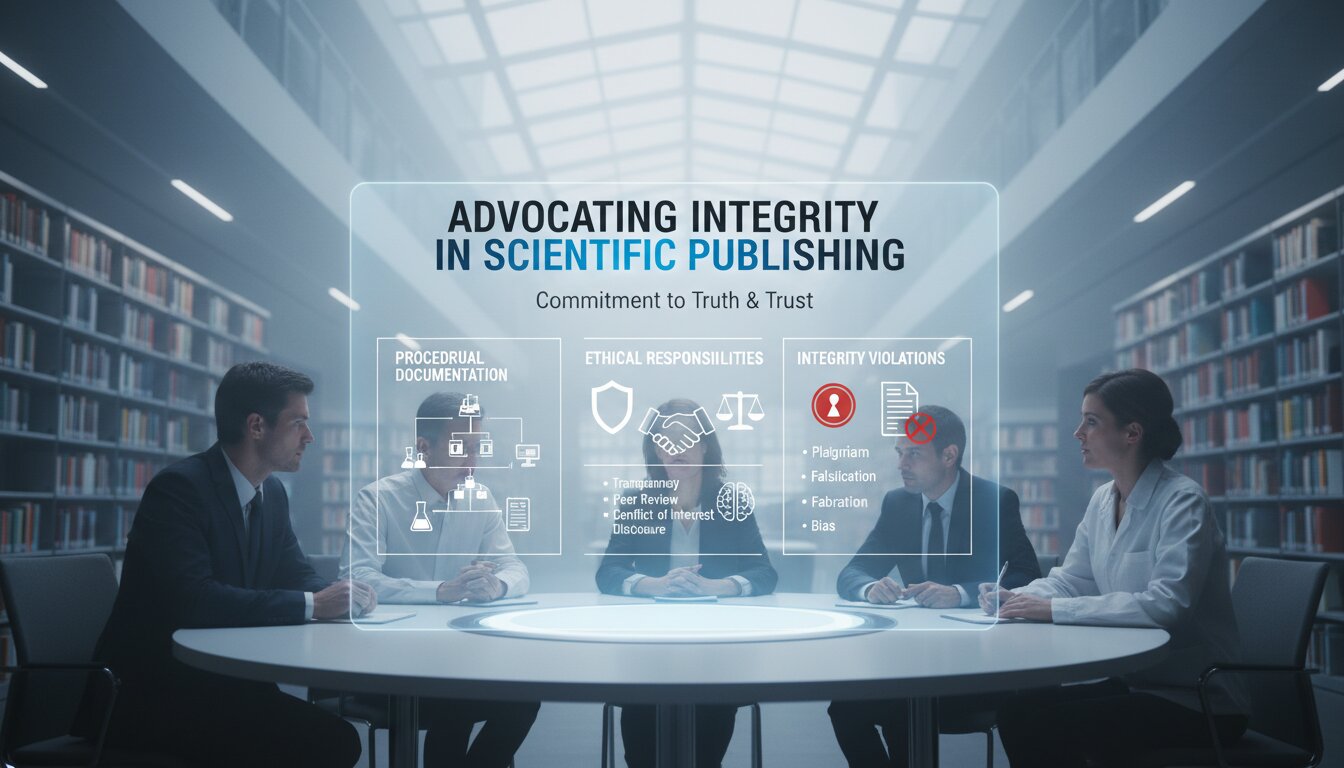
“Integrity is the foundation of credible science; without it, even the greatest discoveries lose their value”
Introduction
The heart of scientific research lies in publishing. New research expands our collective knowledge. As the volume of publications rapidly increases, the publication process is under heavy scrutiny. Consequently, the scientific community is placing more importance on the impact factor, citation counts, and h-index scores. Active efforts to build credibility and trust must be part of the scientific publication process. The trustworthy practices of the publication process, standard ethics, and efforts to address and control misconduct will strengthen the trust of the publishing process.
This blog will cover publication ethics and the frameworks that COPE (the Committee on Publication Ethics) and WAME (World Association of Medical Editors) provide. This will address publication ethics and the frameworks provided by COPE (the Committee on Publication Ethics) and WAME (World Association of Medical Editors) and will focus on some of the issues of concern, such as publication and authorship misconduct and conflicts of interest.
A new idea that is published in a peer-reviewed journal has passed the test of public trust. This trust is built by the journal’s audience and the society it serves. This public trust is a fragile thing, and it will not survive an ethical failure. With a constant and growing volume of published literature, the pressure on all stakeholders to maintain integrity has never been greater. Researchers, editors and their institutions must remain committed to upholding ethical standards and to leaving no area for doubt.

Publishing research with integrity is an integral promise of academia. Candid and thoughtful design, precision in authorship, and thorough consideration for all stakeholders and participants are our ethical obligations. Sadly, we are seeing more and more breaches of trust.
Some authors send the same manuscript for re-review, invent results, appropriate others’ ideas, or erase the name of the true contributor. Each of these actions undermines the trust of the public in science.
To ensure trust remains, every leg of the publication journey must stay on the righteous path, bright and unrelenting. Authors must fully and orderly document the design of the study, the approval of ethics, the letters of conflict of interest, open access data links, and funding sources.
Major journals and universities expect researchers to submit fully documented studies to uphold trust from the moment the study leaves the laboratory.
Integrity and trust are closely linked. This means that the ethical boundaries of scientific research must be respected. The second essential element of integrity research is that the author must respect the publication policy.
Many institutions, for example, the Committee on Publication Ethics (COPE), the International Committee of Medical Journal Editors (ICMJE), and the World Association of Medical Editors (WAME), have defined research ethics. Their guides cover everything from author lists to peer reviews, plagiarism, data protection, and post-publication changes. This advice is valuable to researchers at every level.
Even with all this guidance available, these breaches of integrity keep appearing.
Some mistakes are simple. Some results stem from excessive competitiveness or fraud. Serious issues with publication ethics are caused by many things: faking data, swapping photos, hiding conflicts of interest, including unqualified people as authors, and even the submission of the same article to different journals with no disclosure to anyone.
There are many journals with predatory practices that lure researchers into publishing quickly and with invalid research. These journals, along with article mills, remove the quality checks that validate research. Because of these issues, the research community needs to take the responsibility of defending research integrity.
In this article, we discuss the importance of trust in research and how it affects research integrity. We also describe the different systems, controls, and rules that constrain researchers and enforce honesty in their work.
This article describes how integrity is ensured during research by documenting clear, logical, and thorough procedural steps. It also provides a path of the ethical principles observed during research and publishing, as well as lists the major errors that breach publication ethics.
If you are either a researcher, a student, a mentor, or a reviewer, knowledge of publishing ethics and sustaining publishing ethics is important for the publishing community and your own research. The publishing community is valuable to society, as it ensures both your integrity and that of research and publishing.
Integrity in science publishing is the commitment to reputation and fairness.
They want researchers to know how to share their findings so that they report the full study clearly and honestly.
These guidelines are more than just ideas. They are used around the world! Many reputable journals, publishers, and research facilities integrate these guidelines. The components of these guidelines include:
In science, researchers earn credibility through evidence, preserve it with ethics, and sustain it with integrity
Media and Relations with Organisations:
Gillies can be trusted, as they accurately represent how research is conducted and how publications are reported.
Adherence to CONSORT for reporting clinical trials, PRISMA for systematic reviews, and STROBE for reporting observational studies.
Peer Review Integrity
Fosters the development of a constructive and impartial peer review system.
Offers protection from influence or retaliation in the form of anonymity and confidentiality during the peer review process.
Data Availability and Reproducibility
Incentives or requirements to share data and procedures to promote reproducibility.
Mandate the registration of clinical trials and the preliminary registration of study protocols.
Authorship Criteria and Acknowledgements
Adherence to the authorship criteria set forth by the ICMJE.
Recognition of contributions regardless of authorship.
Correction and Retraction Policies
Rapid, clear, and candid corrections, errata, and retraction.
COPE: Committee on Publication Ethics
Since its inception in 1997, COPE has been at the forefront of publication ethics. It helps editors and publishers navigate ethical dilemmas concerning published research. Some of the many contributions of COPE include:
COPE Guidelines: The guidelines incorporate ethics of authorship, peer review, and other editorial decisions.
Flowcharts: Practical tools used by editors to help with various ethical dilemmas.
Case Database: Curated collection of cases with suggested resolutions.
WAME: World Association of Medical Editors
WAME is a global charity that aims to improve the standards and ethics of medical publication and comprises editors from medical journals.
WAME promotes:
Editorial Independence: Protecting editors from the influences of the market or politics.
Education and Training: Creating resources to help editors understand the ethics of their work.
Consensus Statements: Developed with organisations such as the ICMJE and COPE to draft harmonised ethical frameworks.
Diversity and Inclusivity: Making editorial boards and peer review more representative.
Alongside COPE, ICMJE, CSE, and others, WAME is setting high standards of ethics for research and publication for other initiatives and guidelines. These include:
International Committee of Medical Journal Editors (ICMJE): Clear and unambiguous guidelines of authorship with declaration of interest and trial registration.
Good Publication Practice (GPP) Guidelines: Primarily for research sponsored by the industry.
Open Access and FAIR Principles Data: The scientific community will benefit from easier access to and reuse of scientific data.
These guidelines aim to foster positive change and methodologies that facilitate constructive solutions to unethical behaviour and conflicts of interest.
Conflicts of Interest (COI)
A conflict of interest (COI) can occur when a researcher has personal, financial, or professional relationships that may compromise or seem to compromise their objectivity during their research or in the publication of that research in a scholarly journal.
There are several types of conflicts of interest.
Financial conflict of interest: This type of conflict can occur when a researcher has a relationship with a research subject that may financially benefit from the research.
Academic conflict of interest: Such a conflict occurs when there is a rivalry or competition with other researchers or rival institutions.
Personal conflict of interest: This type of conflict arises when a researcher has a relationship that could affect their impartial decision-making.
Institutional conflict of interest: This situation is when there is an institutional (or stakeholder) bias.
Conflicts of interest can be managed in the following ways:
Disclosing all relevant interests by authors, reviewers and editors.
Editorial control and, as necessary, exclusion from the anticipated decision.
The journal prescribes the use of conflict of interest forms.
The public’s trust in science can be affected by conflicts of interest that are not managed.
“Every signature on a manuscript is a commitment to truth, transparency, and accountability.”
What is Publication Misconduct?
Publication misconduct is when researchers engage in unprofessional behaviour during research, writing, reviewing, or publishing scientific documents.
Here are the most common examples of publication misconduct:
Plagiarism: This is when a researcher fails to cite others or acknowledge the source of their ideas or work.
Fabrication and Falsification of Data: Fabrication is when a researcher makes up data and documents it as having been done in compliance with a scientific process. Falsification is the act of changing data or the methodology of a research process to communicate a misleading result.
Self-Plagiarism (or Redundant Publications): This practice is when the same study is published in multiple journals.
Gift Authorship: This practice involves giving authorship of a publication to someone who failed to contribute the work.
Ghost Authorship
This involves omitting people who helped in the process from the list of authors.
Manipulating the Peer Review Process
Involving made-up reviewers or interfering with the process to alter editors’ choices.
Citation Manipulation
Referring to sources that are not mandatory citations creates a false impression of an increased number of citations.
Publication Ethics Violations, Authorship and Contribution
Even though there are policies and rules in science, unethical actions that compromise scientific research still go unpunished. The most detrimental behaviour centres on those listed as authors and those who assisted with the writing.
Common Violations of Publication Ethics
Ghost authorship, gift authorship, and unacknowledged authorship arise from the attribution of authorship based on prescribed criteria.
Failure to disclose conflicts of interest involves concealing personal or financial connections related to the research.
Actions that are automated or use undeclared external services are classified as AI authoring when automated or external services are used to accomplish work without acknowledgement.
Misrepresentation of ethical approval is claiming authorisation on ethical grounds that were never granted.
The Ethics of Authors and Contributors
Only those who contribute in a significant way to the research should be granted authorship. Those who contribute in a significant way to the research should be granted authorship. Those who contribute in a significant way to the research but do not meet the criteria for authorship should be acknowledged without delay and in an unambiguous way.
Claims of authorship should be viewed as a result of either unclear agreements or a lack of agreements regarding the methods and procedures to be used in the collaborative process. Journals should implement clear authorship policies and author addition statements that emphasise both responsibility and transparency.
Causes of Unethical Behavior
Blend of Personal and System Problems: These factors create an environment that is conducive to unethical behaviour.
Publish or Perish: Incentives and career advancement are based on the publication of papers. Without publications, researchers will not be granted funding, promotion, or tenure.
Lack of Mentorship: There is little systematic training on publication ethics for most researchers.
Competition and Prestige: There is competition to publish, which leads to a greater reputation and prestige based on publications.
Inadequate Staff Oversight: There are insufficient policies and structures for the supervision of staff.
Effects of Irregularity Related to Publication
Publication misconduct is associated with several consequences:
Withdrawal of Articles: This occurs through a formal process damaging a person’s career and reputation beyond recovery.
Loss of Public Confidence: Such an outcome is a serious consequence, especially in the fields of medicine and public health.
Wasted Resources: Irreparably flawed research results in a waste of time and resources.
Legal and Professional Sanctions: Bans from publishing and other forms of prosecution are included.
Combating Misconduct: Collective Efforts of All Stakeholders to Combat the Problem
It is necessary for every author, editor, reviewer, publisher, and stakeholder to:
Sponsorship of Ethical Publishing Workshops: Awareness Campaigns
Creation of Actionable Policies and Policies on Misconduct: Policies should be clearly defined and made actionable
Joining the Ethical Publishing Revolution: Technology Innovations. Develop and implement plagiarism detection and audit trails.
Membership of Ethics Committees and COPE: Support Systems
Conclusion
The preservation of credibility in research and the evolution of knowledge depends heavily on maintaining high ethical standards in academic and scientific publishing. In navigating these ethical standards in publishing, COPE and WAME offer invaluable frameworks and guidance. It must be stressed, though, that all stakeholders must bear responsibility by actively changing how research is approached. There will always be, and there always should be, compliance, and there will always be rationality. It is not necessary to state, but compliance should be the minimum requirement, and trust and respect for the integrity of scholarly work should be the standards for scholarly publishing.
Honesty, transparency, and responsibility form the foundation of the search for scientific knowledge. Thus, for many reasons, integrity in the scholarly publishing system should be stressed in a practical way to support and protect the trust in the framework of science. In previous articles on this blog, we evaluated the importance of ethically conducted research, and we especially stressed the importance of three points: the documentation of the research process, the adherence to the established rules of research ethics, and the elimination of misconduct in research the first time it occurs.
Science is built on transparency and impartiality throughout the process, from the first question to the finished and published research. Comprehensive project notebooks protect research integrity because they document everything and protect researchers against mistakes. These notebooks provide sufficient documentation for others to adequately evaluate research claims and to reproduce research to verify its accuracy.
Pioneering scientists give us their blueprints, guard their data, and analyse their decisions, showing us their processes. Their work strengthens science’s most significant asset, its trustworthiness, and demonstrates what responsible science looks like.
Responsibility in science means being devoted to every step of the process. The scientific community practises responsible publishing standards that prevent working for self-interest or the interests of a particular person or institution.
The publishing ecosystem is like a high-trust vault. Researchers, universities, editors, peer reviewers, and journals must always be vigilant and maintain high standards. For the scientific community, responsible publishing means every reagent, every page, and every instruction set.
Tragically, and more often than we want to admit, our awareness of scientific responsibility has led to preventable breakdowns, especially when ethics training is subpar. These include unethical publishing practices like ghost or fabricated authorship, data fabrication, manipulated citations, or especially egregious practices like plagiarised or duplicate manuscripts. These unethical actions destroy the scientific record and erode public confidence in our work.
These examples illustrate that universities and publishers alike need to have stricter but fair policies and better systems to prevent misconduct. The responsibility to create a stable publishing ecosystem is the academic community’s, especially research groups, and needs continuous ethics training that is relevant to emerging challenges of publishing.
Peer reviewers need to remain objective, and journal editors need to apply guidelines with consistency. With respect to research integrity, university-wide policies must be explicit, consistently applied to all investigators, and continuously improved with training, reporting, and auditing that are proactive, clear, and accessible.
There are no simple answers when dealing with the protection of the integrity of research publications.
Integrity is the core component of research.
Where integrity is valued, research can be trusted to be accurate and useful to society.
“The true legacy of a researcher is measured not by the number of publications, but by the trustworthiness of their contributions”
Research integrity is most needed when the methods and speed of research and publication are advancing. The demand for faster publishing, real-time global collaboration, and cross-border research is more important than ever.
The publishing of research combines the efforts of the worldwide research community and brings results to the population hungry for new knowledge. It is also a reflection of what the research community values. For this reason, scholarly integrity must be the focus of the research community. Currently, the system of academic research and publishing is crumbling. Research integrity is now at an all-time low.
The publishing of research combines the worldwide efforts of the research community and brings results to those who are most interested. Researchers feel pressure to publish, and the systems for publishing research are evolving rapidly. Research integrity is under threat.
“A publication may advance a career, but integrity advances science”
My Publications or visit my LinkedIn