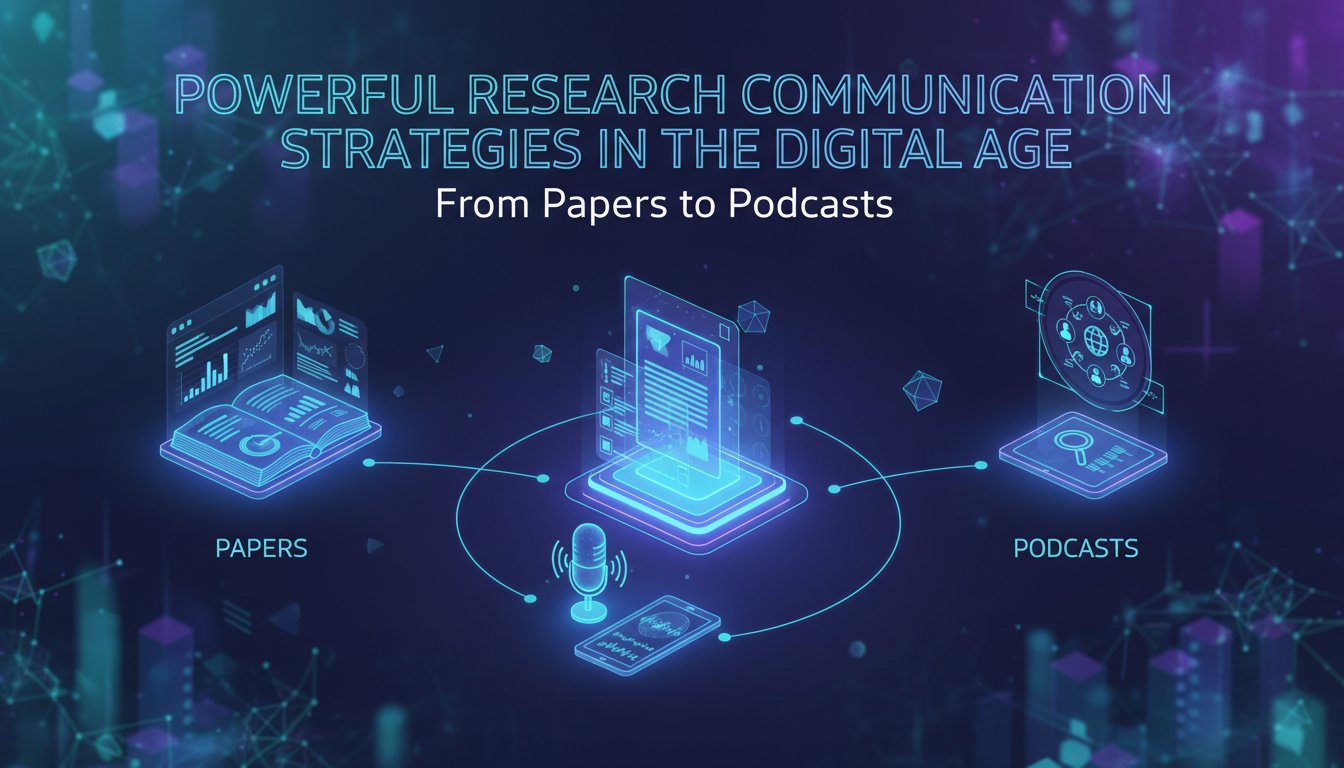
Powerful Research Communication Strategies in the Digital Age: From Papers to Podcasts (2026)

“In the digital age, research communication is no longer just about publishing papers—it is about inspiring conversations through every platform, from journals to podcasts.”
The main goal of research communication is to disseminate new knowledge, improve the accessibility of findings, and involve peers and the public. The academic paper has served as the main vehicle for this exchange for hundreds of years and undergoes extensive peer review, formatting, and adaptation to specific disciplines. However, the nature of communication itself is undergoing rapid changes. The main goal of academic inquiry for most of history has been to create knowledge and to enable as many people as possible to access it.
The first cuneiform inscriptions and illuminated manuscripts, and later printed books, public lectures, and communications in general, have all aimed to communicate insights fairly, transparently, and with consideration. For decades, published journals have been the main vehicle for communication, enabling findings to be peer reviewed and published. However, new technologies have transformed how we publish research and how we read and learn from it.
As such, the ways in which we communicate our enquiries go well beyond printed paper.
Scholarly journals are still essential, but digital tools have spread research beyond what journals can do. Blogs, podcasts, infographics, webinars, social media, and videos are all channels that work alongside traditional publications to engage audiences more quickly, with fewer barriers to access. Research presented in these formats is more accessible and more engaging. The tools have changed, but so have the expectations. Academics are being asked to move the research discourse beyond the campus, beyond traditional publications, and into more accessible formats for the public and policymakers.
The research community has responded to these challenges in three main ways.
The first is that the scale and complexity of global challenges have made it more important to provide research in a form that is ready for action. The global challenges include climate change, digital rights, food security, and others.
The ability to communicate research in a clear, engaging, and thoughtful way is essential for keeping it relevant and useful to both society and the research community, especially in an environment with overwhelming data and growing scepticism toward research.
The Old Reliable: Academic Papers
What They Do Best
Certainly, the backbone of science is still peer-reviewed journals. They provide the precision, depth, and the necessary seal of approval to ensure that others can do research in the future. Needed respect, promotions, and a place in the discipline are all provided by publishing papers. They form an enduring record of research and detail and cite methodology.
Where They Fail in a Digital Age
However, traditional paper formats fail to offer anything to a wider audience in the digital space. The overly formal writing style can be off-putting to the general reader. Experts are also the only people familiar with the design and format conventions, which include abstract, intro, methods, results, and discussion. When digital formats dominate with short attention spans, rapid scrolling, and multimedia, a traditional locked 6000-word article is not going to capture the attention of anybody outside a small academic audience.

Growth of Digital Formats
Research Blogs and Medium
Blogs cross the boundaries that research articles create. They allow researchers to articulate ideas, drafts and reflections. These reach out to a wider audience, including students, researchers, and the general public. These articles promote discussion that research articles alone cannot achieve.
Visual Aids
Research publications and conferences now focus on vivid representations of research abstracts. These representations promote research and assist the research community in growing.
Research and Social Media
Research has now adapted to the social media landscape. Researchers can share results, ask questions, and share snippets of daily lab life through social media.
Real-Time Formats
Real-time formats include conferences, online seminars, and research streams. These formats promote real-time research dissemination and question answering. The time differences and research recording promote continual, global research discourse.
Research Podcasts
Research podcasts allow the research community and the general public a wider, closer representation of research.
This sound-based format enables researchers to connect their findings to real-life examples, convey their doubts, and document their stories. This format transports people into different mental spaces and works best when they are listening while doing mundane tasks like driving, taking walks, or resting.
Examples of Popular Formats Used by Researchers
Sole-Show: One researcher discusses recent publications, a core question, or a new debate.
Interview Series: A host interviews scholars, policymakers, or community members to discuss multiple perspectives of the work.
Panel Style: Researchers host a discussion to explain their field notes and research critiques.
Narrative Documentary: An audio-guided film to the field, lab, or archives to explain a research team’s documentation of data.
Benefits and Challenges
In contrast to the documentation style used in research publications, which typically includes only the data and statistics, a podcast provides a human face to the data. A podcast that minimises the use of documented jargon, while also entailing careful time management and sound quality, maximises participation. The most challenging step in the process is simplifying complex theories to document them using sound.
Integrating Multiple Formats
The Multi-Channel Strategy
To increase the outreach of their work, many researchers have begun developing it in a number of different formats. This begins with the writing and publication of the peer-reviewed article. Researchers then develop their work in blog format, develop a visual abstract, record their findings in a podcast, and disseminate their work over social media. This method increases the credibility of the researchers, as well as providing the opportunity for different audience members to access the information in their preferred format.
Sequencing and Timing
A well-structured timeline may include the publication of the article, a blog post with a summary of the big takeaway, a visual abstract, a podcast, and then social media posts that continue the conversation.
The goal is to give each format the opportunity to build on the work of the previous formats.
Consider Audience and Platform Tones
Each platform has different audience members, and researchers and writers should consider the audience. Readers on LinkedIn focus on the most practical, while podcast listeners prefer narrative and blog readers prefer in-depth content.
Broader Reach and Public Engagement
Digital formats extend research beyond the university and increase public engagement. Public access to research results enables the public to participate in and influence the decision-making process, ultimately increasing trust among constituents.
Interdisciplinary Bridges
Digital formats reach beyond singular disciplines. A podcast can host and facilitate research dialogue for a biologist, economist, and social scientist. The potential for collaboration through a digital format is immeasurable compared to traditional publishing formats.
Career Visibility and Reputation
People compare the digital presence of researchers to the traditional scholarly CV. Researchers who publish and communicate their research digitally receive contact from other researchers, journalists, and media, who then offer opportunities. Promotion and grant committees consider the digital presence and outreach of researchers to actualise impact beyond the research process.
Feedback Loops and Open Dialogue
Digital formats create real-time access to research for the public, increasing the potential for researchers to receive comments, critique and defend their research. Research also benefits greatly from public access, digital formats, and real-time dialogue. The research concept may even improve before peer review.

Best Practices for Digital Research Communication
Stay Authentic and Clear
Use simple language. Readability is the most important part of communicating research. It is important to be clear and honest when describing how research was conducted. This increases trust.
Link to Full Research
Always include links to research publications and accompanying datasets.
Digital formats can make things easier, but they should also lead interested readers to the deep dive for more context.
Presenting Information Ethically
Data integrity is vital, whether it’s a graph, a chart, or a photograph. Images that misrepresent the data lose the message and the trust of those that see them.
Amazing communication is ethical
Representing scientific data poses ethical challenges, even in a world that prioritises speed. Resist the temptation of clickbait oversimplification; avoid frightening headlines that never end. Clarity and trust take time to build.
Keep the Brand the Same
Keeping the brand the same makes it easy to identify consistent work: the same tone, logo, and tagline. Quality always outweighs quantity; posting meaningful things less frequently is always better.
Provide Accessibility for All
Always include captions for both videos and podcasts. Choose colours and backgrounds that are easy to read. Make sure sounds are balanced so everyone can follow, not just the lucky few.
Digital Research Communication Success Stories
Example 1: Three Ways to Tell the Same Carbon Research Story
After a climate scientist published research on carbon capture, he published a podcast that combined the research with the stories he had gathered during his visits. He published visual stories on his website, and he finished it with a public webinar. As a result, his research was covered in the media, he received new questions related to policy, and he collaborated with a variety of other fields.
Example 2: The Endless Molecule Thread
The molecular biologist cut the key findings of her free-access paper into a thread on Twitter/X. A visual summary was placed in each post, and readers were encouraged to ask questions. Because the thread was popular, the new grant reviewer took interest and earned her a keynote position in an international conference.
Example 3: Anthropology in a Digital Studio
An anthropologist created a six-part podcast series based on her book research. Each podcast contained field stories, interviews, and site sound. This series was a way to create new media, a larger audience, and new virtual contacts.
She can engage those outside the screen and walls of academia, such as community leaders and teachers, by interviewing and diving into archives. Academia, community organisations, and educators may all cite her in their work.
Common Pitfalls and Ways to Avoid them
Expanding in Excessive Channels
Being overly active on a vast number of platforms may be mentally draining with little to no reward. Select the platforms your audience uses most and make them come alive. A single podcast that is edited and polished, along with some stylish graphics, may be more effective than an abundance of tweets that go live with little thought.
Foregoing Peer Review
Digital formats may be used in conjunction with a peer-reviewed document but should never take their place. Always provide a framework for your statements and cite the supporting literature.
Issues of Privacy and Consent
If you are documenting field notes, photographs, or quotes, you may need to ask for permission. Remember these guidelines when publishing.
Stick to maintaining confidentiality and data privacy, regardless of whether your audience is public or interested.
Misleading Simplicity
It’s great to share your research in a way that makes it easy for people to understand, but you shouldn’t sacrifice the details that make your work important.
Conclusion
Currently, digital research communication provides methods to disseminate research that researchers did not previously have. Traditional methods like a peer-reviewed manuscript can now be communicated through digital channels like narrative podcasts. Digital research communication combines blogs, infographics, short audio recordings, and social media and provides the opportunity to stimulate debates and discussions beyond research disciplines.
Digital research communication does not “dumb down” research. Instead, it makes it easy to understand and sticks the idea in the audience’s memory.
To communicate research effectively, you need to present your research in a clear and structured manner, honestly share your methods and research data, and be able and willing to answer questions and address comments at your research dissemination presentation. Using digital communication methods to communicate research does not replace traditional methods. Rather, it integrates them and provides additional dimensions to promote research communication.
Despite the digital research communication methods that make research easy to understand and disseminate, research communication is still about building relationships.
With traditional journal articles situated beside blogs, podcasts, and other multimedia, researchers can connect to global audiences, not just their peers.
Quick standing ovations cannot replace rigour and scholarship, and this shift does not require that kind of trade-off. This shift does provide newer tools to engage with society. The process of peer review and publication remains valuable, but other media such as blogs and videos provide more access and reach and evoke more of an audience or emotional connection. For example, an illustrative podcast can engage listeners and explain a theory or concept in a much more digestible format.
Social media and other newer digital public domains provide rapid means to share information and receive audience feedback. Traditional blogs offer a public avenue for scholars and provide a quiet space for them to organise their thoughts and research. Combined, these new digital tools ensure research is an iterative process.
Unlike the research community, the public digital community poses a significant threat to research integrity through the rapid communication of misinformation. The effects of research-orientated innovation are temporary if scholars do not protect the integrity of their findings. Wise researchers do not compromise the integrity of their findings for the sake of simple wording. Finding this balance between simplicity and accuracy or clear communication and integrity fosters a popular appeal while keeping the highest academic standards. Always with careful empathy, researchers address a diverse audience comprised of laypersons and scholars as well as policymakers and students.
Research has an inherent obligation to society that prompts continuing investigation and discourse. Rigour and careful consideration of research findings deserve more than being left in a restricted database. With the lack of informed decision-making in the constantly changing and data-rich society, the ability to explain research comprehensively is the most valuable innovation. Digital tools are shaping the future of communication.
Researchers are called to consider both the art of discovery and the art of communicating their discoveries.
The shift from printed papers to podcast episodes significantly marks an evolution in how scholarship is lived. Knowledge is no longer confined to dusty tomes or inaccessible libraries. Now it exists in live lectures, tweets, threads, and audio series that reach the globe.
The evolution of scholarship into online and open-access formats has allowed researchers to reach broader audiences, facilitate interdisciplinary conversations, and make research more accessible, understandable, and relevant to everyday life.
Along with each of the new opportunities incorporated into scholarship, new responsibilities are assumed.
The work necessary to transform research into the public domain in an articulate, accurate, and engaging manner relies on intention and practice. It is the responsibility of the universities, research programmes, and member societies to create workshops on the use of the digital medium, storytelling, and the ethical use of research. Researchers also need to consider that they are more than specialists; they are public thinkers, teachers, and storytellers.
Research communication can connect knowledge to the actions of society. It is the responsibility of the researchers to see that their research creates impact, whether it is communicated via a traditional research paper or a podcast.
Mastering powerful and simple expressions will enable you to engage people who admire thoughtful and clear ideas. You will not only be heard; you will also direct and lead future conversations and ideas.
My Publications or visit my LinkedIn